
Services // Computer Vision
Computer Vision
Cameras that count, inspect and find things. We build vision systems for shelves, warehouses, conveyor lines and consumer apps, and we run them in production.
YOLO-family · ResNet · ArcFace · OpenVINO · Jetson · Datapipe
What computer vision does for operations
Computer vision puts a tireless pair of eyes on a repetitive visual job. A camera watches the shelf, the gate, the belt or the phone screen. A model turns each frame into facts: what is there, how many, in what condition. Your systems receive those facts as alerts, counts and reports.
It pays off where people currently walk, look and write things down: shelf checks, goods-in inspection, sorting lines, quality gates. Typical wins are fewer manual rounds, earlier defect catches and numbers a team can plan against. One constraint to respect: a model learns from examples, so lighting, camera angles and packaging variety all matter. Measuring that fit is what a pilot is for.
When this makes sense
You need this if
- A visual check repeats many times a day and someone walks over to do it
- You can put a camera where the work happens, or CCTV is already there
- Examples exist: the objects can be photographed, or a dataset can be collected in a few weeks
- Someone on the ops side will own the alerts and act on them
- You want numbers per hour and per shift, straight to a dashboard
Not for you if
- The check happens a few times a month: a person is cheaper
- Every object is unique and there is nothing to learn from
- Nobody owns the process the alerts would feed
- You need 100% accuracy with zero human review: no vision system promises that
Architecture
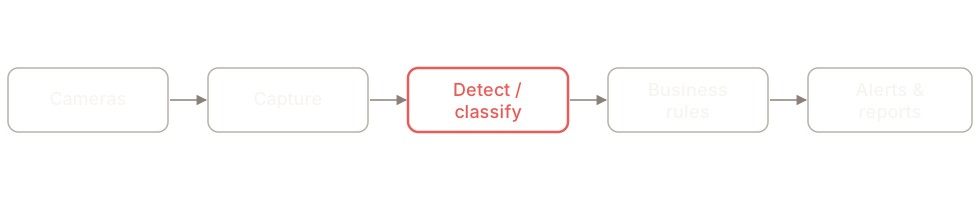
Every deployment is this pipeline with different weights. Cameras capture, models detect and classify, business rules decide, your systems receive alerts and reports.
Use cases
Twenty ways this shows up in operations. Filter by your industry.
Knowledge map
How we think about vision systems, shelf by shelf.
Conceptual
Modeling
Production
- An active-learning loop for shelf annotation
- Breaking a CV quality ceiling: yes/no labeling and an incremental data pipeline
- Choosing cameras for shelf recognition
- Cutting the annotation bill without losing accuracy
- Datapipe: recompute only what changed in a 59-step ML pipeline
- Detecting camera drift on retail shelves
- Why planograms drift, and how monitoring catches it
- Automating price-tag and promo checks
- When product recognition makes mistakes: causes and fixes
- Two years of shelf monitoring: a map of the CV pipeline
Every engagement starts with an eval that tells us, and you, when a model is good enough to ship. After that it is the integration and the monitoring that keep it working on the line, shift after shift.
What does a CV system cost?
Vision work usually lands in the Complex tier of our estimator: your objects, your lighting, production hardening. Cumulative, with the ±15% promise we use everywhere on this site.
- Working PoC about 8 weeks €31-41k typical
- A system that ships about 16 weeks €61-83k typical
- Production grade about 32 weeks €122-166k typical
Lighter builds cost less, regulated ones cost more. A pilot that proves or kills the idea is the cheapest thing we sell.