
Robots that see, classify, and sort, turning mixed waste into clean recycling streams
Computer-vision-guided robotic arms identify and separate waste into material categories, plastic, glass, metal, cardboard, at industrial throughput. The ECOBOT system in production today.
Discuss a pilot →Quick facts
- Business size
- Recycling facilities, waste management operators, municipal sorting plants
- Timeline
- 6-10 weeks test, 3-6 months pilot, 6-12 months production
- Budget range
- Full robotic system from €250k+. CV module alone (for integration with existing robot) from €60k.
- Hardware
- Conveyor and robotic arm (your existing or integrator's), industrial cameras, Jetson-class edge compute.
- Data needed
- Examples of waste objects per material class. Initial corpus ~500-2000 images per class.
- Evolution
-
- Genesis
- Custom-built
- Product
- Commodity
A vendor sells this result ready-made. We set it up and tune it to you.
What this scale means
Further right means more proven and cheaper. Further left means newer and riskier. Here is the test for each step.
- Commodity
- You could get the result yourself from a ready service, with almost no work. We rarely take these on.
- Product
- A vendor already sells this result turnkey, like shelf recognition from Trax or document reading from ABBYY. If one of them fits you, use it. You come to us when it does not: when it has to run on your own servers, cost less, or fit systems the product cannot reach.
- Custom-built
- Vendors sell only the parts. A tool like Tableau hands you charts, but the dashboards and metrics for your business still have to be built. That build is the work, and that is us.
- Genesis
- The approach exists but does not work reliably yet. You are betting on it maturing, so it costs more and carries more risk.
Expected outcomes
The Problem
Manual waste sorting is hard, dirty, dangerous work. Sorters stand by a conveyor, picking out recyclables from mixed waste streams, breathing in fine particulates, handling sharp objects, working in difficult ergonomic conditions. Even the best human sorters miss material. Fatigue, attention drift, and items moving too fast all take a toll. The result is contaminated recycling streams that fetch lower prices on commodity markets, or get rejected outright by processors.
The economics of recycling depend on stream purity. A bale of “clean PET” sells; a bale that’s 15% contaminated by other plastics or organic matter goes to landfill. Manual sorting hits a ceiling on both throughput and purity that the labor market cannot economically push past.
CV-guided robotic sorting has been a promised future for a decade. The technology actually shipped in production deployments in the past five years. What holds most facilities back is integrator availability. The underlying ML is ready.
What the Solution Does
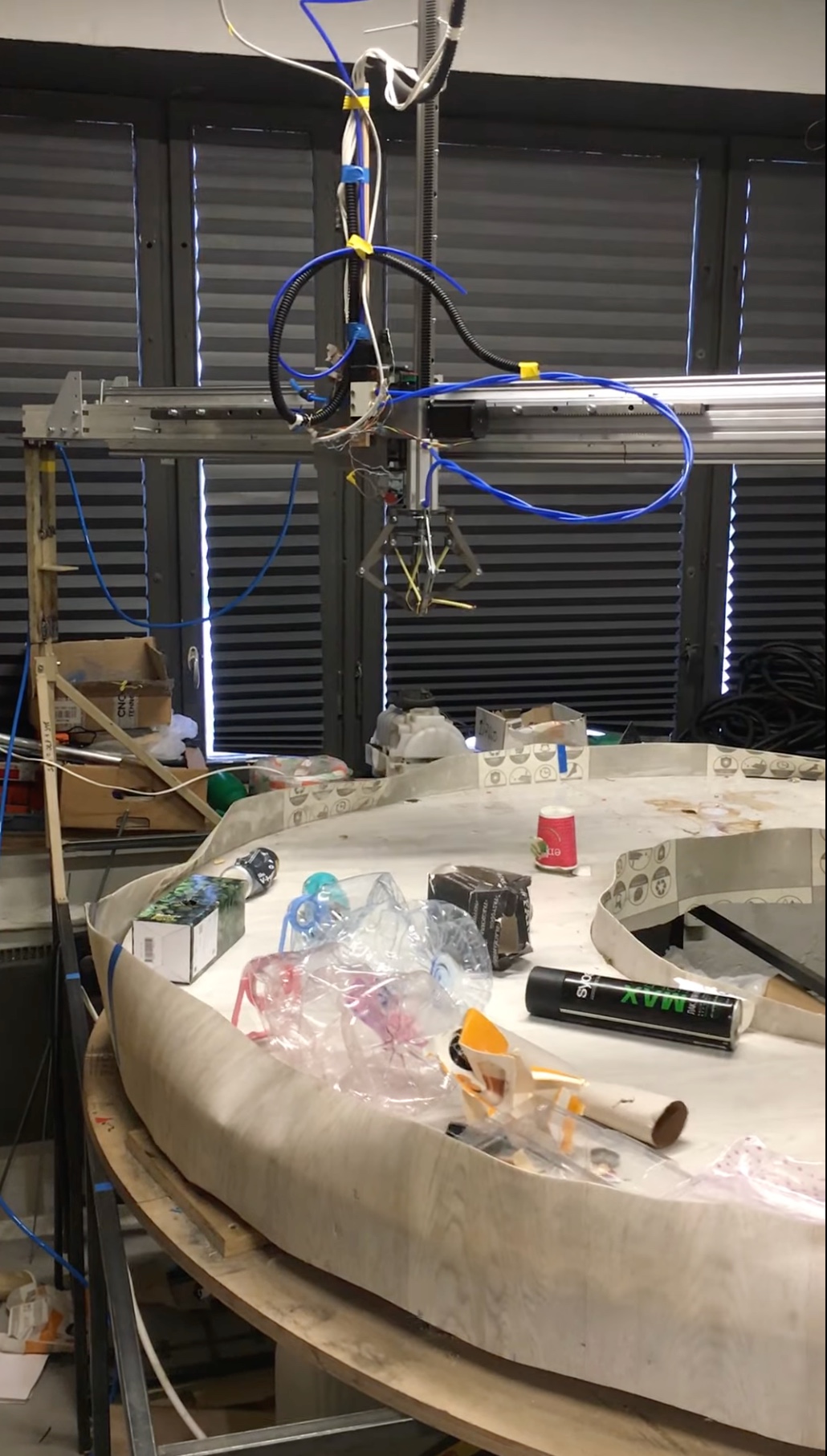
A robotic sorting station: conveyor moves mixed waste under a camera. Computer vision identifies and localizes each object. A robotic arm picks classified items off the conveyor into the right stream.
- Intake, mixed waste is placed on a conveyor (often pre-shredded or pre-classified at coarse level).
- Capture, cameras image the conveyor; CV detects objects and classifies them (plastic, glass, metal, cardboard, paper, organic, etc.).
- Coordinate calculation, for each detected item, the system computes the 3D coordinates and trajectory for the robotic arm.
- Arm action, the arm grips the item and deposits it into the correct stream container.
- Feedback, items the system can’t classify confidently go to a “manual review” stream. The system avoids a forced, wrong guess.
Where It Fits
This makes sense if you…
- Operate a recycling facility, MRF (Materials Recovery Facility), or municipal sorting plant
- Have measurable cost from contaminated output streams or from manual sorting labor / safety incidents
- Are ready to invest in the full robotic infrastructure (conveyor, arm, and CV together are a capex commitment)
- Have a sortable waste stream, i.e. pre-handled enough that individual objects are visible on the conveyor
- Have facilities for the rejected / unclear stream (the system is never 100%; you need a manual fallback channel)
This is probably not the right time if you…
- Sort small volumes, the capex doesn’t pay back below a throughput threshold
- Handle waste streams where objects are heavily entangled or shrouded. Here, physical separation comes first; CV does not solve that step.
- Don’t have a buyer for the cleaner output streams, the value-add depends on the market for purity-graded materials
- Need full 100% recognition with no manual fallback, that’s not what CV delivers
Business Value
Labor displacement on hazardous work. Manual sorting work is among the most labor-shortage-stressed in industrial recycling. Robotic sorting eliminates the most ergonomically-difficult and safety-risky positions. The labor reduction is typically 60-85% on the sorted streams, depending on which materials are being sorted and at what throughput.
Stream purity, which translates directly to commodity pricing. A 95% pure PET bale sells at a 30-50% premium over a 75% pure bale. CV-guided sorting consistently delivers purity ratings that manual sorting can match but not exceed at scale.
24/7 operation. No shift breaks, no fatigue degradation across a shift, no overtime cost for night runs. The conveyor runs whenever you want it to.
Throughput linearity. You add sorting capacity by adding cells, each one a conveyor, arm, and CV unit. No need to hire more people in a labor-constrained market.
How It Works
The ECOBOT system we built is the canonical version of this pattern.
1. Intake handling
A physical bag of trash is opened (automated bag-cutting at the system level) and contents dispersed onto the conveyor. The conveyor moves at a controlled speed compatible with arm cycle time.
2. Camera and detection
Cameras (typically two: one overhead, one angled) capture conveyor footage. The CV pipeline runs object detection, CenterNet works well for the high-density-of-small-objects scenes typical of mixed waste; YOLO-family also fits. Frame rate target is 4 FPS, which gives the arm enough cycle time to process each frame’s detections.
3. Classification
Each detected object gets a material class from a curated set (in ECOBOT: 8 object types covering plastic, glass, metal, cardboard, and several sub-categories). ResNet50 is the classifier backbone, pretrained on ImageNet, fine-tuned on your specific waste stream.
4. Arm trajectory calculation
For each classified object, the system computes pickup coordinates (image pixel to 3D space via depth camera or fixed-geometry calibration), then plans the arm trajectory: approach, grip, lift, traverse, drop into target container, return. The CV-to-robotics translation is the part most integrators underestimate.
5. Confidence-based fallback
Objects with low classification confidence go to a manual-review stream. The system avoids a forced, wrong label. The threshold is tunable: we typically start conservative, with a high rejection rate, and tighten it as the model improves.
6. Continuous improvement
Manual-review decisions feed back via Datapipe into retraining cycles. New material types or new packaging variants get added to the model in 2-4 week cycles.
Stack
CenterNet detection, ResNet50 classification, ZED2i / industrial RGBD camera, ROS-integrated robotic arm control, Jetson Nano (ECOBOT) or Jetson Xavier / Orin for higher-throughput variants, Datapipe for the retraining pipeline, Metabase for ops metrics.
What You Need to Make This Work
Data. Initial corpus of 500-2000 images per material class, in lighting and orientation conditions similar to your conveyor. We help collect during test phase.
Integrations. Conveyor infrastructure with controllable speed. Robotic arm with ROS-compatible control. Camera mounting points with stable lighting. Container infrastructure for the sorted streams.
Hardware. Jetson-class edge compute. Industrial cameras. The robotic arm and conveyor (existing capex or new procurement, we work with integrators on the mechanical side).
Team. A facility-ops lead. A robotics-integration partner if you don’t have in-house (we can recommend). A maintenance team that’s prepared for the continuous-improvement workflow (data tagging, model approval cadence).
Implementation Roadmap
1. Test (6-10 weeks)
Single material stream, single arm. Collect data, train baseline, integrate with arm, measure end-to-end throughput and accuracy. Output: a working sorting cell, measured numbers, recommendations for production.
2. Pilot (3-6 months)
Extended production trial, typically running alongside manual sorting at first, then progressively shifting volume. Tune for your specific waste mix. Output: production-grade deployment, accuracy and throughput benchmarks, ROI numbers.
3. Production (6-12 months)
Scale to additional cells / additional streams. Continuous retraining as your waste mix shifts seasonally or with new material types. Your team owns day-to-day; we stay on for retraining oversight and new material onboarding.
Keep in Mind
The limits, stated plainly:
- The CV is the small part of the project cost. The conveyor, arm, container handling, and facility integration all dwarf the ML budget. Plan total cost of ownership accordingly.
- Throughput vs accuracy is a real trade-off. A faster conveyor leaves less inference time per frame, so accuracy drops. A slower conveyor raises accuracy and lowers throughput. The sweet spot is per-facility.
- New materials require new training. A model trained on PET, HDPE, and cardboard cannot handle aluminum cans without retraining. Each material class costs a data-collection and retraining cycle.
- Contamination is fractal. A “plastic” stream still has internal sub-classifications (PET vs HDPE vs PP). How granular you go is a business decision based on your buyer market.
- Manual fallback is necessary. No CV system reaches 100% on real waste streams. You need somewhere for the rejected items to go, either back to manual or to coarser secondary processing.
- Safety zoning matters. Robotic arms operating at industrial speeds need proper safety zoning, especially with humans potentially near the conveyor. This is a facility-engineering decision, handled outside the CV layer.
FAQ
Can this run on existing recycling infrastructure?
It depends on the conveyor and arm. We’ve adapted to existing infrastructure where possible. New builds give us more flexibility, but retrofits work when the underlying mechanical setup is compatible.
What material categories do you support?
Initial deployments typically cover 4-12 categories. Common: plastic (PET, HDPE), glass (clear, colored), metal (ferrous, non-ferrous), cardboard, paper, organic. Niche categories (medical waste, e-waste, hazardous) are possible with appropriate training data.
What’s the throughput per cell?
ECOBOT runs at 4 FPS. Higher-throughput variants on Jetson Orin AGX or dedicated GPU servers can reach 10-15 FPS. Arm cycle time is the other constraint, typical industrial arms cycle at 1-3 picks per second.
How does this handle items the model has never seen?
The classifier returns a confidence score. Low-confidence items are rejected to manual review. The rejected items become training data for the next retraining cycle.
Is this safer than manual sorting?
Yes, on the dimensions of repetitive strain, sharps exposure, and air-quality. The robotic cell needs its own safety engineering (zoning, e-stops, emergency response), but the human exposure to direct waste handling drops dramatically.
Ready to Discuss?
If you operate recycling or waste-management infrastructure and labor or stream purity is a real cost, this is the right conversation. We’ll talk through your waste mix, your conveyor and arm setup, and your buyer market, and tell you what a CV-guided sorting cell would cost and what to expect.
Part of: Computer Vision ↗