Document every shipment objectively, with no walk-arounds and no after-the-fact disputes
A 360° camera stand inspects each load on arrival: it classifies the packaging, finds defects, measures dimensions, weighs it, counts units, and ships a shipment card to your WMS. All linked to one QR code.
Discuss a pilot →Quick facts
- Business size
- Enterprise warehousing, 3PLs, FMCG distribution
- Timeline
- 4-6 weeks test, 2-3 months pilot, 4-9 months to scale
- Budget range
- Pilot starts at around €40k (single stand). Hardware (cameras, structure, and scale) is a separate line item.
- Hardware
- Inspection stand: metal frame, multiple cameras for 360°, an integrated industrial scale, and a display for operator instructions. ArUco-marker calibration.
- Data needed
- Reference photos of packaging types and defect examples. We ship with a base library and fine-tune on your conditions.
- Evolution
-
- Genesis
- Custom-built
- Product
- Commodity
No product gives you this. We assemble and train it around you.
What this scale means
Further right means more proven and cheaper. Further left means newer and riskier. Here is the test for each step.
- Commodity
- You could get the result yourself from a ready service, with almost no work. We rarely take these on.
- Product
- A vendor already sells this result turnkey, like shelf recognition from Trax or document reading from ABBYY. If one of them fits you, use it. You come to us when it does not: when it has to run on your own servers, cost less, or fit systems the product cannot reach.
- Custom-built
- Vendors sell only the parts. A tool like Tableau hands you charts, but the dashboards and metrics for your business still have to be built. That build is the work, and that is us.
- Genesis
- The approach exists but does not work reliably yet. You are betting on it maturing, so it costs more and carries more risk.
Expected outcomes
The Problem
Bad inspection records cost a 3PL money on every disputed claim. Here is how the loss happens. Cargo arrives at the dock. Someone walks around it with a phone, takes a few pictures, and writes “received with damage” or “received clean” on a clipboard. They sign and move on to the next load.
When a customer later disputes a damage claim, the record falls apart. The photos are missing, the angle was wrong, the weight was never recorded, the unit count is approximate. The 3PL absorbs the loss or argues it out. Multiply that by hundreds of shipments a day across a network of warehouses, and a 30-second-per-load process becomes a real liability.
The people doing it are not the problem. Human inspection is subjective and inconsistent, and it produces an evidentiary record that does not hold up. Computer vision (cameras plus software that reads the image) was built for exactly this: repeatable, objective measurement at machine speed.
What the Solution Does
You get a complete, auditable record of every load in under a minute, with no clipboard. A 360° inspection stand does the work: a metal frame with cameras on all sides, an integrated scale, and a display that walks the operator through the inspection. The cargo gets placed on the scale, photographed from every angle, measured, classified, and documented in around 30-60 seconds. Everything links to a single QR code.
- Load. The operator places cargo on the scale and scans a QR code (or the system generates one).
- Capture. Cameras photograph from all sides. Depth and ArUco calibration give 3D coordinates.
- Segment. The system identifies the packaging type (cardboard box, wooden crate, barrel, rolls, and so on) and outlines each unit.
- Detect defects. A separate model finds visible damage: tears, holes, dents, wet spots, broken pallets, and suspicious shortages.
- Measure. Dimensions come from the 3D point cloud and weight comes from the integrated scale.
- Generate shipment card. Packaging type, dimensions, weight, unit count, and marked defects all get stored against the QR code, all retrievable later.
The whole thing pushes to your WMS or ERP and to your customer-facing reporting on shipment receipt.
Where It Fits
This makes sense if you…
- Run a warehouse or 3PL receiving dozens of inbound shipments per day, per dock.
- Have a real cost from damage disputes, where you either eat them or argue them.
- Need consistent, auditable documentation of received-cargo condition.
- Can install a fixed inspection stand at the receiving dock (the system is not portable).
- Want the inspection record to flow into a digital workflow, so it does not stay as paper.
This is probably not the right time if you…
- Receive a few shipments a week. The manual process is fine at that volume.
- Handle highly varied packaging that changes faster than you can collect training images. We can adapt, though the time-to-accuracy is longer.
- Need to inspect inside sealed packages. This is external inspection only.
- Don’t have receiving dock space for a fixed installation. The stand is around 3-4m³ and bolted to the floor.
Business Value
The hard return shows up in three places.
Speed at receiving. Manual inspection takes 1-3 minutes per shipment when done thoroughly. The system takes around 30-60 seconds and produces a better record. Typical reduction in per-shipment inspection time is 50-80%, depending on what your baseline actually was. The bottleneck then shifts to the operator placing cargo on the scale, which becomes the limit.
Dispute defense. Every shipment has a complete photographic record from six angles, with timestamps and defect annotations. When a carrier or shipper argues “this wasn’t damaged on receipt”, you have evidence. We have seen damage-related dispute volume drop by around 30-60% after deployment, though that range varies a lot with the baseline dispute process.
Compliance and customer reporting. Some categories (chemicals, regulated goods, high-value freight) require documented receipt inspection. The system produces it automatically, in a standard format, attached to the WMS record. This is the kind of capability that wins or loses contracts in tendering.
We stay deliberately conservative on lost-sales-recovery or audit-cost-reduction claims. Those depend on your baseline operations, so we measure them per project.
How It Works
The pipeline below is what we shipped for ACI (Automatic Cargo Inspection). The architecture is reused with project-specific tuning.
1. The stand
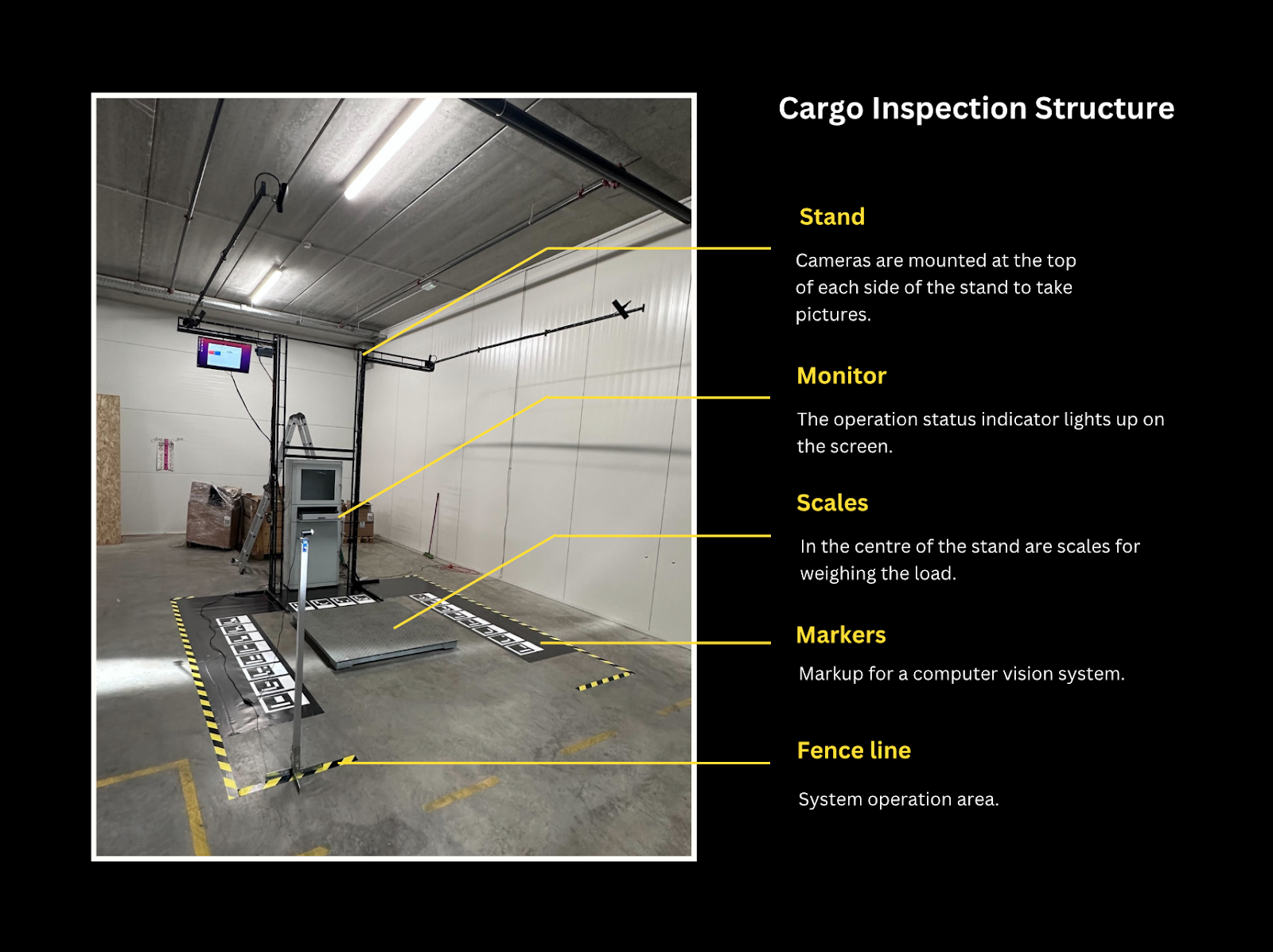
A rectangular metal frame, around 3-4m wide and 3m tall. Cameras are mounted on all four sides at the top, looking down and inward. An industrial scale sits in the middle. An operator-facing display shows on-screen instructions (“place cargo”, “remove cargo when light turns green”, “scan QR code”). ArUco markers on the floor sit at known coordinates: these are how the system links 2D image pixels to real-world 3D coordinates.
2. Segmentation (YOLOv8)
The system runs segmentation to identify packaging type. It uses eight micro-classes (unpackaged, barrels, wooden crate, wooden boxes, cardboard boxes, bags, rolls, other) and six macro-classes (film-covered variants of the above). The segmentation also produces the polygon outline of each unit, which feeds into dimensional measurement.
3. Defect detection (YOLOv5)
A separate detection model finds visible damage. It currently handles torn film (a hole or dangling pieces), open gaps in the load, film not covering the top, torn packaging, pierced packaging, crumpled bags or boxes, suspicion of shortage (a non-standard count in the top row), broken pallets, and wet cargo. Each defect produces a bounding box, a class, and a confidence score.
Detection and segmentation run independently. The system then combines them to know where on the cargo each defect is located.
4. Dimensional analysis (3D point cloud)
Each pixel in a segmented image has a depth value (from camera calibration and stereo). The system converts every depth point to 3D coordinates using the ArUco-calibrated transformation. It then builds a point cloud, filters noise and outliers, and calculates length × width × height from the extremes of the cloud. Camera calibration is the most important step: get this wrong and dimensions are off by around 10%.
5. Unit counting
Multiple cameras give multiple views. The system matches bounding boxes across views, knowing which object is the same physical object in each camera, and counts unique units.
6. Continuous fine-tuning (Datapipe)
The system gets more accurate over time. Every week, our team (or yours, after handoff) reviews errors flagged in the previous batch: a wrong packaging class, a missed defect, a dimensional miscalculation. We tag those, and Datapipe figures out which downstream training stages need updating, so only those get re-run. New defect types or new packaging classes get added the same way.
Quality is tracked through Precision, Recall, and F1 (weighted and macro) in a Metabase dashboard. When the F1 on a class drops, that is the signal to fine-tune.
Stack
YOLOv8 handles segmentation and YOLOv5 handles defect detection. ResNet-class encoders run the classifier head. Datapipe runs ETL and incremental retraining, Label Studio handles annotation, Django runs the admin interface, and Metabase shows metrics dashboards. Compute is typically on-prem (the inspection stand is local), with cloud backup for retraining workloads.
What You Need to Make This Work
Data. Reference photos of your typical packaging. The system ships with a base model covering common types. For unusual packaging (custom crates, branded film, irregular pallets), expect a 1-2 week data collection sprint during the test.
Integrations. A WMS or ERP API for shipment record sync. The QR code or barcode standard your operations already use. An operator workstation for the on-screen instructions (any modern web browser).
Hardware. The inspection stand (metal frame, 4-6 industrial cameras, integrated scale, display, networking), which we spec and source. Floor space at the receiving dock, plus electrical and network drops. For new installations, a typical stand takes 2-3 days to install.
Team. A receiving-ops lead who will own the workflow change. A WMS or IT contact for integration (around 15-25 hours during pilot). Operator training is short, around 30 minutes per person, since the display walks them through every step.
Implementation Roadmap
1. Test (4-6 weeks)
Install one stand at one warehouse. Collect data on your packaging mix. Train the first model. Measure baseline accuracy on your real shipments. Build the WMS integration. Output: a working stand at one location, a written report with measured accuracy on your conditions, and a list of packaging types that need additional training before scale.
2. Pilot (2-3 months)
Run the stand in production for one shift on one dock. Tune defect detection for your specific cargo mix. Set up the weekly fine-tuning workflow. Train operators. Output: a production deployment at one warehouse with documented accuracy, a dispute-handling workflow integrated with the photo evidence, and a go/no-go on multi-warehouse rollout.
3. Scale (4-9 months)
Roll out to additional warehouses and additional docks per warehouse. Standardize the maintenance and retraining schedule. Build the multi-warehouse analytics layer to compare performance across sites. By the end your team operates day-to-day, and we stay on for retraining cycles and edge cases.
Keep in Mind
The limits of the system, stated plainly:
- External inspection only. It cannot see inside sealed packaging. For internal-content verification you need additional tooling (weight comparison, X-ray for some categories).
- Light and angle matter. Drastically different lighting (outdoor vs indoor, daylight changes, fixture replacement) typically requires a short retraining cycle. The system flags low-confidence frames and avoids guessing.
- New packaging means new training. A brand-new packaging type the system has not seen will be classified as “unknown” with low confidence. We add new types through the weekly Datapipe pipeline. It is fast, though not instant.
- The stand is physical infrastructure. Installation, electrical, network: this is not a SaaS deployment. The first warehouse takes longer than the rest.
- Defect detection is probabilistic. F1 on “torn film” is high (around 0.85-0.90). F1 on “suspicion of shortage” is more variable. We give per-defect-class numbers during pilot in place of a single headline number.
FAQ
How accurate is “accurate”?
The metric differs per layer. Packaging classification is around 90-97% F1 across micro and macro classes. Defect detection varies by defect type: around 0.85-0.90 F1 on well-trained classes like torn film, lower (around 0.70) on harder classes like “wet” or “suspicion of shortage”. Dimensional accuracy is typically within 2-3 cm on each axis, depending on cargo geometry. We surface all of these explicitly during the pilot.
What about defect types specific to my industry?
We can train them. Pharma, chemical, and food each have their own defect vocabulary. Adding a new defect class typically takes 2-4 weeks of data collection and fine-tuning. The pipeline holds.
Does this replace the human inspector?
It does not, by design. Cases with low system confidence are flagged for human review. The human time per shipment drops sharply, though it does not go to zero. You keep one operator on the dock for placement, exception handling, and the edge cases. That operator gets the system as a tool that saves them time.
Can this work with our existing cameras?
For inspection at this density and angle precision, dedicated cameras on a fixed stand are required. Existing CCTV can supplement the inspection cameras (security, perimeter), though it cannot replace them.
Is the data ours or yours?
Yours. All photos, defect annotations, dimensional measurements, and shipment records stay in your infrastructure. We use anonymized errors for our base-model improvement only with explicit contractual agreement.
Ready to Discuss?
If you run a receiving operation where damage disputes, slow throughput, or audit compliance is a real cost, this is worth a discovery call. We will talk through your current inspection process, your dispute history, and your dock layout. Then we tell you plainly whether a pilot stand will pay for itself and on what timeline.