Verify every pack, without slowing down the packer
Cameras watch what items go into each box, check against the order, flag missing or wrong items in real time, and document the pack with photos linked to the order ID.
Discuss a pilot →Quick facts
- Business size
- E-commerce fulfillment, 3PLs, warehouse operators with significant pack volume
- Timeline
- 4-6 weeks test, 2-3 months pilot, 4-8 months network rollout
- Budget range
- Pilot from €35k per station. Capex scales with station count.
- Hardware
- Overhead and side cameras for item recognition, Jetson-class edge compute, on-station display, barcode reader integration.
- Data needed
- Product catalogue with reference images. Examples of typical pack composition and pack mistakes.
- Evolution
-
- Genesis
- Custom-built
- Product
- Commodity
No product gives you this. We assemble and train it around you.
What this scale means
Further right means more proven and cheaper. Further left means newer and riskier. Here is the test for each step.
- Commodity
- You could get the result yourself from a ready service, with almost no work. We rarely take these on.
- Product
- A vendor already sells this result turnkey, like shelf recognition from Trax or document reading from ABBYY. If one of them fits you, use it. You come to us when it does not: when it has to run on your own servers, cost less, or fit systems the product cannot reach.
- Custom-built
- Vendors sell only the parts. A tool like Tableau hands you charts, but the dashboards and metrics for your business still have to be built. That build is the work, and that is us.
- Genesis
- The approach exists but does not work reliably yet. You are betting on it maturing, so it costs more and carries more risk.
Expected outcomes
The Problem
Mis-packs are a recurring, expensive friction point in fulfillment. The customer ordered three items; the box contains two. Or three of the wrong size. Or the right items but missing the gift card. The downstream cost is a customer-service ticket, a return-shipment subsidy, a refund, sometimes a lost customer.
Manual verification, having the packer double-check before sealing, adds seconds per pack at scale where seconds matter. Sampling, auditing 1% of packs, finds individual mistakes but doesn’t prevent the rest. The result is that most operations accept a baseline mis-pack rate and absorb the customer-service cost as part of doing business.
Camera-based verification is the third option: continuous monitoring that catches mis-packs at the station before the box is sealed, without slowing down the packer.
What the Solution Does
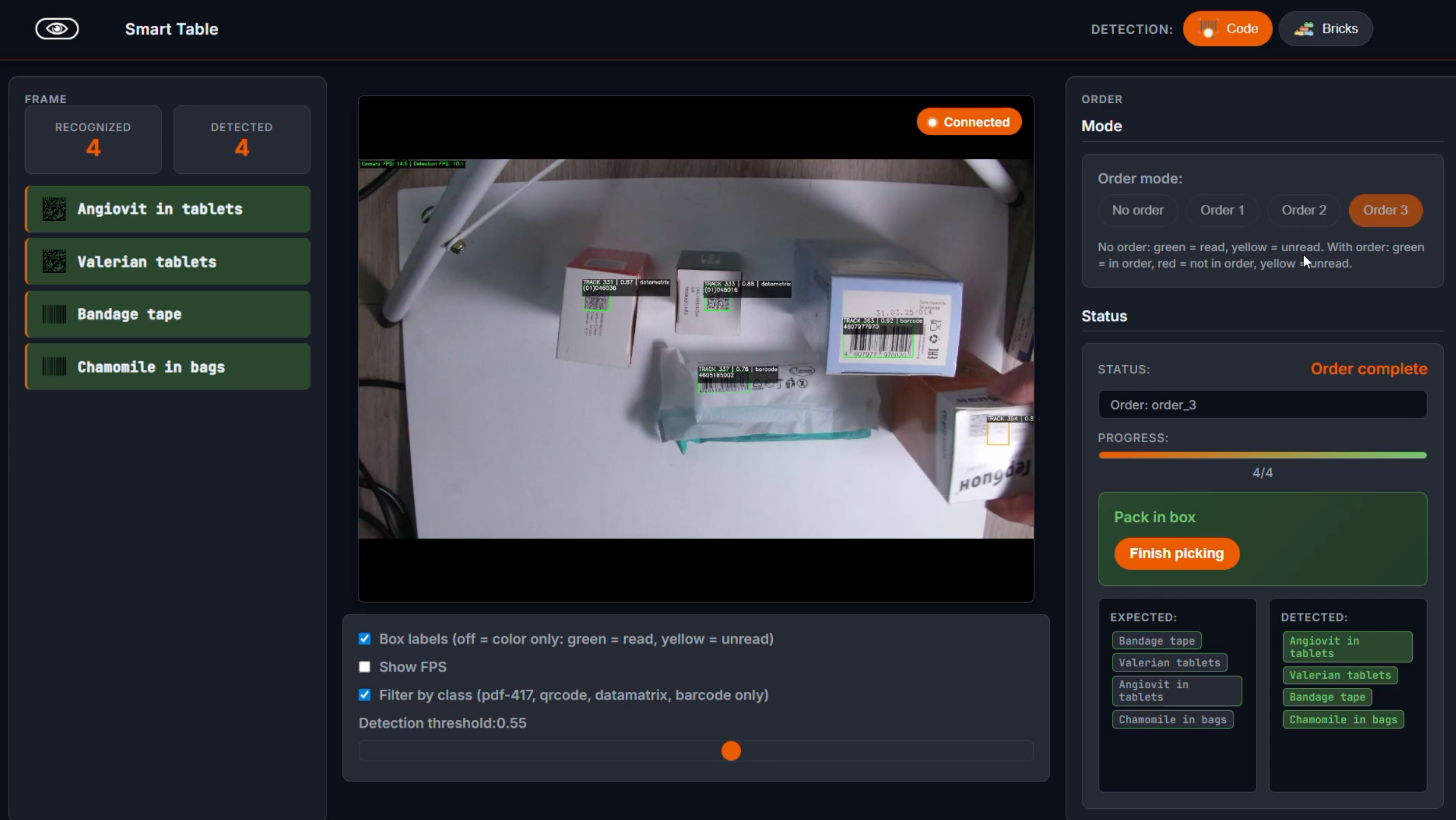
Cameras over the packing station watch what’s being packed. The system identifies each item as it enters the box, compares against the order, and flags discrepancies in real time.
- Order context, the system knows the order before the pack starts: it reads the order ID (from a label, a barcode, or your WMS API) when the packer begins.
- Item-by-item recognition, as items enter the box, cameras detect and classify them against the order.
- Real-time feedback, the on-station display shows verified items in green, missing items in yellow, wrong items in red.
- Seal-time check, when the packer signals “ready to seal”, the system does a final check. Discrepancies block the seal action (or just alert, depending on configuration).
- Documentation, a final photo and verification record linked to the order ID, ready for customer-service evidence or audit.
Where It Fits
This makes sense if you…
- Operate fulfillment at meaningful scale (1,000+ packs a day)
- See real cost from mis-packs, customer service, returns, churn
- Have packing stations with stable layouts that can accommodate camera mounting
- Have a structured product catalogue with reference images (or can build one)
- Can integrate with your WMS or OMS for order context
This is probably not the right time if you…
- Pack a low volume where manual verification suffices
- Pack highly varied items with no reference imagery and no time to build a corpus
- Have packing stations so dynamic that camera setup can’t be stable
- Need verification of internal product properties (correct color, correct version, correct serial number that a camera cannot see), which need additional barcode or serial scanning
Business Value
Customer-facing mis-pack reduction. Mis-packs reaching the customer typically drop by 50-80%. The range varies sharply with the baseline: operations with strong existing verification see smaller improvements, and operations with little see larger.
Customer-service ticket reduction. Each mis-pack avoided is a ticket avoided. The net effect is typically a 30-60% reduction in pack-related CS volume, depending on the baseline.
Documentation and dispute defense. Every pack has a photographic record and verification log. “We packed this order correctly” stops being a claim and becomes evidence. This matters for high-value goods, regulated categories, and chargeback disputes.
Operator throughput. The system runs in parallel with the packer and adds no waiting steps. The net effect on throughput is neutral, sometimes slightly positive, because the packer makes fewer mistakes that require a re-pack.
How It Works
The architecture is closer to cargo inspection than to a sorting robot. It is a fixed station with cameras and a display. The system watches and flags; it takes no autonomous action.
1. Station setup
One or two overhead cameras provide top-down coverage of the pack box. Optional side cameras for items that need 360° identification. An on-station display shows real-time verification status. Barcode reader for the order label.
2. Order context
The packer starts the pack by scanning the order label or pulling the next order from the WMS queue. The system loads the order contents and begins watching for those specific items.
3. Real-time item recognition
As items enter the box, the detection model finds them and the classifier matches against your catalogue. When confidence falls below threshold, the item gets flagged for manual confirmation. The system does not guess on a low-confidence call.
4. Display
The display shows the order: each line item with a green check (verified), yellow check (visually similar but uncertain, confirm please), or red (not yet seen). The packer sees their progress in real time.
5. Seal check and record
When the packer signals “ready to seal”, a final verification pass runs. If everything matches, the system records the pack and the packer seals. If not, the packer adjusts. Either way, the final photo and verification log get archived against the order.
6. Integration with WMS
Pack records flow back to your WMS / OMS, useful for CS evidence, returns processing, and chargeback dispute defense.
Stack
YOLO-family detection and ResNet classification, Datapipe for retraining as the catalogue evolves, Jetson Orin or Xavier for edge inference, a web-based on-station display, and REST API integration with the WMS.
What You Need to Make This Work
Data. Product catalogue with reference images per SKU (3-5 photos from typical pack angles). Examples of typical pack composition. If reference imagery doesn’t exist, we run a data-collection sprint as part of the test phase.
Integrations. WMS or OMS read access for order context. Barcode reader at the station. Network for data export. Optional: writeback to WMS for pack records.
Hardware. Cameras and a Jetson Orin per station, plus a display and station mounting hardware. We spec everything during the test phase.
Team. A fulfillment-ops lead for workflow design. A WMS or IT integration contact (around 15-25 hours during the pilot). Packers benefit from a brief training session (15-30 minutes per person) so they understand the display feedback.
Implementation Roadmap
1. Test (4-6 weeks)
One station. Install cameras, display and Jetson. Train the first model on your top-volume SKUs. Wire up WMS integration for order context. Measure recognition accuracy and impact on pack time. Output: written report with measured numbers and recommendations for production rollout.
2. Pilot (2-3 months)
Roll out to 5-10 stations in one warehouse. Tune confidence thresholds with operators. Build the dashboards for CS and ops teams to use pack records. Output: working production deployment, measured mis-pack reduction, go/no-go on warehouse-wide rollout.
3. Production (4-8 months)
Add more stations and more warehouses. Continuous retraining as the catalogue evolves. Your team owns day-to-day; we stay on for retraining and new product onboarding.
Keep in Mind
Where it breaks:
- The system verifies what cameras can see. Internal properties (correct serial number on a sealed component, correct color of an internal item) need additional scanning steps. CV is the outer layer. It works alongside other checks.
- Mis-packs of visually-identical items can slip through. Two product variants that look identical (two sizes of one shirt, two flavors of one drink with similar packaging) need extra discrimination: a barcode scan paired with CV. CV alone will not separate them.
- Catalogue churn is real work. Every new SKU needs reference imagery and a retraining pass. Operations with high catalogue churn (new SKUs daily) need a structured workflow for adding them.
- Pack workflow needs to support the display. The packer needs to look up at the display occasionally. If your packing station is highly cramped or the display angle is awkward, the system loses value.
- Lighting and pack-box reflectance matter. Shiny boxes, glare from overhead lights, and packing-material reflections all degrade recognition. Camera positioning during the test phase addresses these.
- Verification doesn’t prevent packing errors that happen before the station. Wrong picking and wrong staging need upstream interventions. Pack verification is the last line of defense. It works alongside the earlier checks.
FAQ
Can this work with our existing packing stations?
Usually yes. We install cameras, a display and edge compute alongside existing infrastructure. The packing process itself doesn’t change. We assess station-specific feasibility during the test phase.
How does this integrate with our WMS?
Read-only access for order context is the minimum. Optional writeback for pack records (recommended, that’s where customer-service value comes from). We’ve integrated with most major WMS systems via REST API.
What’s the impact on pack throughput?
Neutral to slight reduction in pack time on average. The system runs in parallel with the packer; nothing waits on inference. Some operations see small throughput gains because mis-packs that would have required re-work get caught at the station.
How does this differ from barcode-scan-each-item verification?
Barcode-scan-each-item is the conventional CV alternative. It works, though it slows packers down with per-item scan time. Camera verification is faster, with no per-item action by the packer, and it is probabilistic, with lower accuracy on visually-similar items. Many operations use both: barcode for items that need it, CV for items where speed matters more.
Can the system block the seal if there’s a mismatch?
Yes (configurable). Some operations want hard blocks; others want only alerts. We support both modes.
Ready to Discuss?
If you operate fulfillment at meaningful scale and mis-packs are a real cost line, this is a measurable-ROI deployment. We’ll walk through your station setup, your catalogue, and your WMS, and tell you what to expect from a single-station pilot.