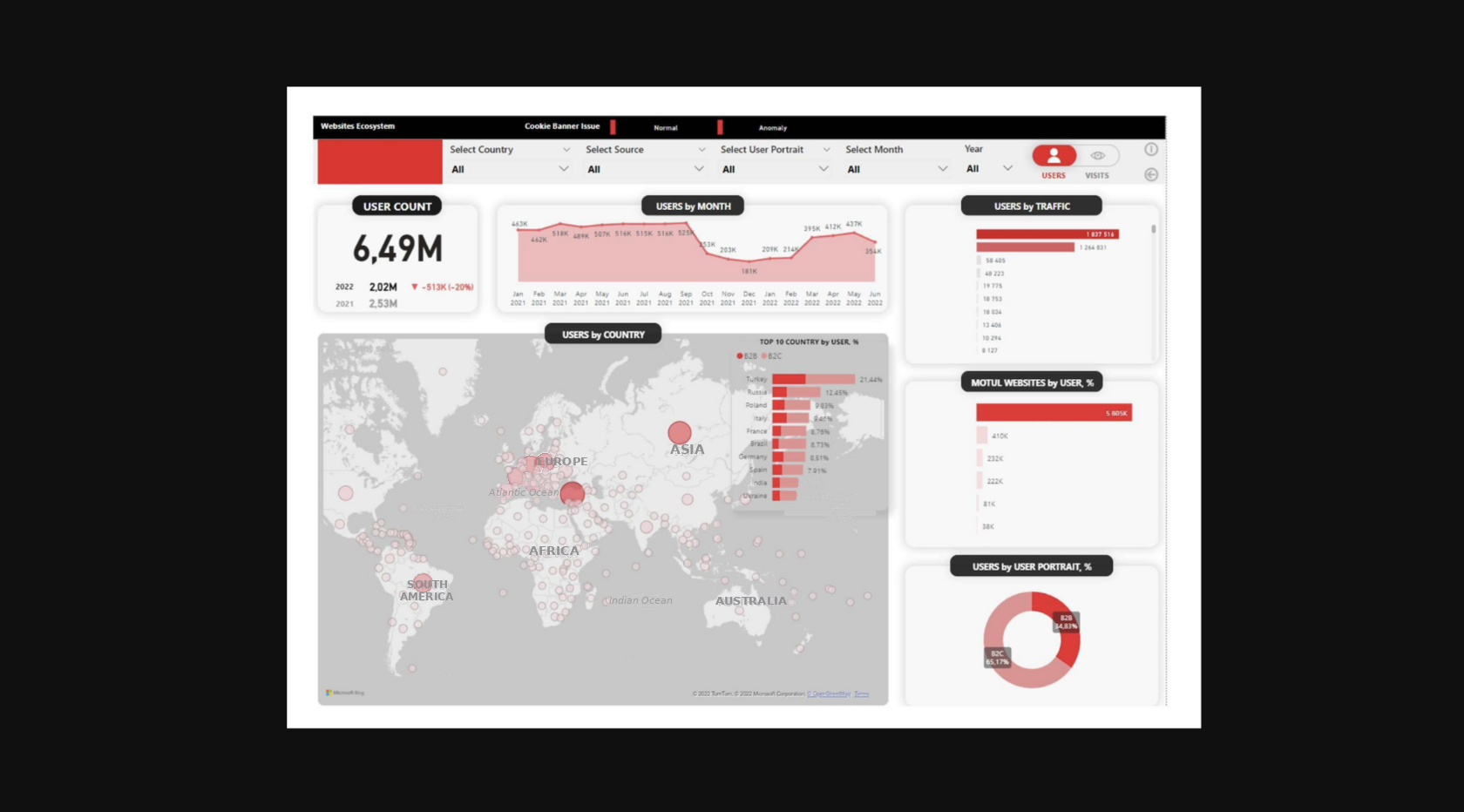
Your analytics is wrong, let's find out where
A systematic audit of your web / mobile / server tracking. What's instrumented, what's broken, what's missing. Foundation work that makes downstream marketing analytics, CDP, and attribution trustworthy.
Discuss a pilot →Quick facts
- Business size
- Any operation depending on web / app analytics for decision-making
- Timeline
- 3-5 weeks audit, 1-3 months remediation, ongoing maintenance
- Budget range
- Audit from €15k. Remediation scope varies.
- Hardware
- None, analysis of your existing tracking.
- Data needed
- Access to GA4, GTM, mobile analytics, server logs, tag-management systems.
- Evolution
-
- Genesis
- Custom-built
- Product
- Commodity
No product gives you this. We assemble and train it around you.
What this scale means
Further right means more proven and cheaper. Further left means newer and riskier. Here is the test for each step.
- Commodity
- You could get the result yourself from a ready service, with almost no work. We rarely take these on.
- Product
- A vendor already sells this result turnkey, like shelf recognition from Trax or document reading from ABBYY. If one of them fits you, use it. You come to us when it does not: when it has to run on your own servers, cost less, or fit systems the product cannot reach.
- Custom-built
- Vendors sell only the parts. A tool like Tableau hands you charts, but the dashboards and metrics for your business still have to be built. That build is the work, and that is us.
- Genesis
- The approach exists but does not work reliably yet. You are betting on it maturing, so it costs more and carries more risk.
Expected outcomes
The Problem
Most analytics setups have problems nobody knows about. Events that fire twice on certain pages. Events that don’t fire at all on the new mobile version. UTM parameters that get stripped before they reach the warehouse. Server-side tracking that works for 90% of users and silently fails for the rest.
The downstream cost is analytical decisions made on broken data. Marketing teams optimize against numbers that aren’t what they think they are. Executive dashboards show trends that reflect tracking changes more than business reality.
Detecting these issues isn’t easy. Each individual event seems to work in isolation. The cumulative reliability problem only surfaces when you compare data sources or look for cohort-level patterns.
A systematic audit catches what ad-hoc debugging doesn’t. It’s foundation work, boring compared to “build new attribution”, but it’s what makes the new attribution actually trustworthy.
What the Solution Does
A systematic audit of your tracking infrastructure with a remediation roadmap.
- Inventory, what events should be tracked vs. what is tracked.
- Test, automated and manual testing of every important event across browsers, devices, OS, session types.
- Compare, cross-validate platform reports against server-side / warehouse data.
- Diagnose, identify what’s broken, what’s mis-firing, what’s missing.
- Roadmap, prioritized remediation plan with implementation guidance.
- Optional remediation, we implement the fixes if you don’t have in-house capacity.
Where It Fits
This makes sense if you…
- Depend on web / mobile analytics for marketing or product decisions
- Have inherited an analytics setup that’s grown organically
- Are about to invest in attribution, CDP, or BI infrastructure (audit first so downstream is reliable)
- See data discrepancies between platform reports and reality
- Have substantial discrepancies between marketing-reported and actual numbers
This is probably not the right time if you…
- Just deployed tracking and have a fresh implementation
- Don’t depend on the data for material decisions
- Don’t have the resources to act on findings
Business Value
Discovery. Typical audits find 15-40% of events with issues and 5-15 critical missing events. The percentage feels small until you realize what decisions those events drive.
Foundation for downstream investment. Attribution, CDP, dashboards, all become more reliable when the tracking they’re built on is solid.
Trust recovery. When teams know the data is reliable, decisions move faster.
Specific remediation roadmap. The deliverable is a concrete document, fix this event, add this one, replace this implementation. Not “your tracking has problems” but “here are the 23 specific things to fix in priority order”.
How It Works
1. Inventory
We compare your business taxonomy (“what should be measured”) to your current tracking implementation (“what is measured”). Gap analysis surfaces missing events.
2. Automated testing
Headless browser tests on critical user paths. We instrument the test environment to verify every event fires as expected.
3. Manual testing
Real-device testing for cases automation can’t cover: in-app webview events, complex multi-page flows, mobile-specific scenarios.
4. Cross-validation
Compare GA4 / GA / Yandex Metrica numbers vs server-side data (from your DB, your CDP, payment processor records). Discrepancies surface mis-instrumentation.
5. Privacy / consent compliance
GDPR / CCPA / cookie-consent validation. Many “tracking issues” are actually privacy-mode behaviors getting misinterpreted.
6. Remediation roadmap
Output: prioritized document, what to fix, why it matters, how to fix, expected impact.
Stack
Custom test harnesses, GA4 / GA / Yandex Metrica APIs, Tag Manager inspection, server-side log analysis, Datapipe for the data correlation work.
What You Need to Make This Work
Data. Access to GA4, GTM, server logs, mobile analytics. Tag-management access.
Integrations. Read access, we don’t modify production tracking without explicit approval.
Hardware. None, analysis of existing.
Team. Marketing analytics lead. Engineering contact for implementation questions. Tag-Manager admin for access.
Implementation Roadmap
1. Audit (3-5 weeks)
Inventory, testing, cross-validation. Output: written audit document with prioritized remediation roadmap.
2. Remediation (1-3 months)
Implement the fixes. We can do this or your team can, depends on capacity and complexity.
3. Ongoing monitoring
Set up monitoring so future tracking issues get caught quickly. Quarterly audit refresh on top of monitoring.
Keep in Mind
- Most audits surface uncomfortable findings. Some decisions made on bad data turn out to have been wrong. Stakeholder communication matters.
- Remediation can be substantial. A 23-item remediation list isn’t a one-week project.
- Cookie deprecation reshapes tracking. Forward-compatibility is part of the audit.
- Server-side tracking is the future. Most audits recommend at least partial migration to server-side. We walk you through the trade-offs.
- Privacy compliance is non-negotiable. Some tracking practices that “worked” historically are now non-compliant. We surface this.
FAQ
How does this differ from GTM-vendor tools (ObservePoint, etc.)?
Commercial tracking-audit tools automate a lot of testing. Our approach combines automation with business-context manual analysis. We check what your tracking should be doing, then what it actually does.
What about server-side tracking?
Increasingly important. We cover server-side and client-side audit, and recommend migration paths where appropriate.
Cookie consent / privacy?
First-class audit dimension. Many “tracking issues” are privacy-mode behaviors that look like bugs.
Do you implement the fixes?
Optional. Audit-only or audit-plus-remediation. Depends on your team capacity.
Ready to Discuss?
If your analytics has been growing organically and discrepancies are showing up, this is foundation work worth doing. We’ll walk through your current setup, and tell you what to expect from the audit.