e8.team: Programmatic Design and an Agent Content Pipeline

- Seed
- PoC
- MVP
- Production
- Chasing perfect
Our own site, built and maintained without a designer or a content team. The logo is computed from a Fourier series, every cover is rendered at build time, and a marketplace of Claude skills takes a project from a description in a chat to a published page.
Where the design comes from
The brand as math
We wanted our own site to look like the rest of our work: built by code, the same way we build the products. The sister product Vedana already uses a procedural mark, a rose curve that breathes between a clover and a circle. For Epoch8 we wanted to carry that same math forward in its own shapes.
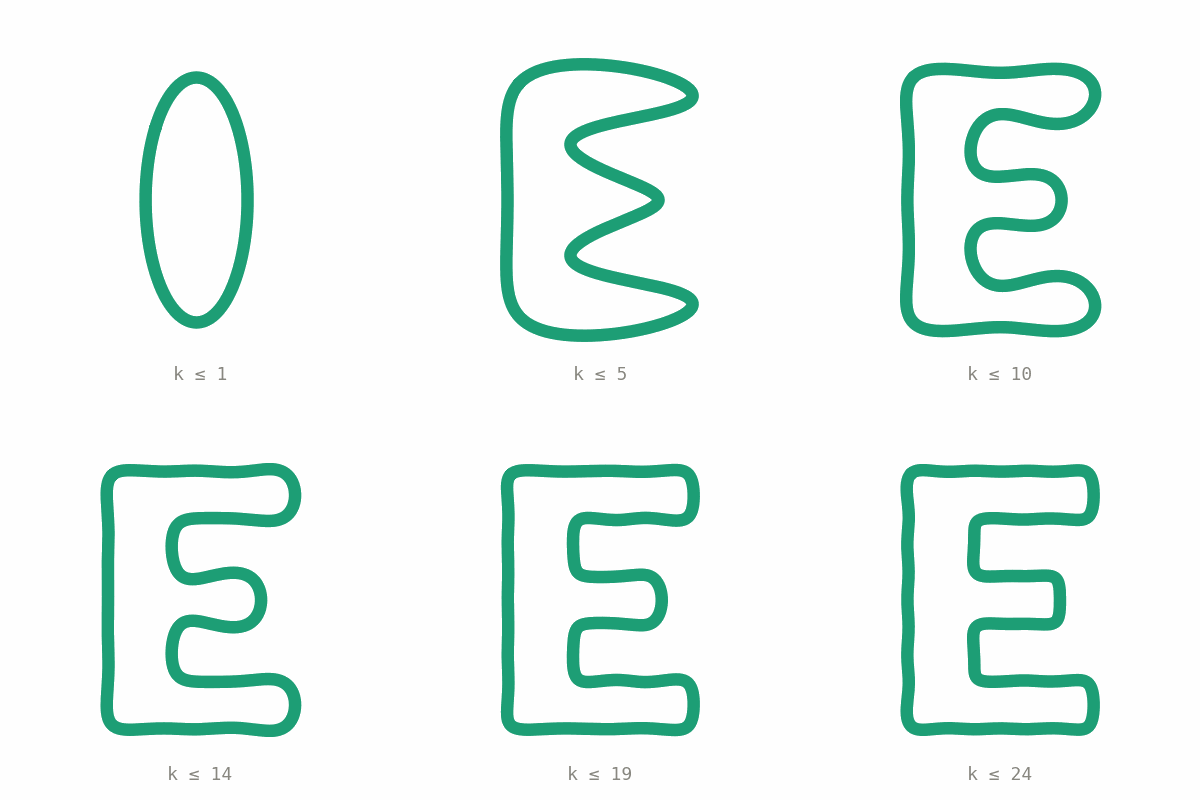
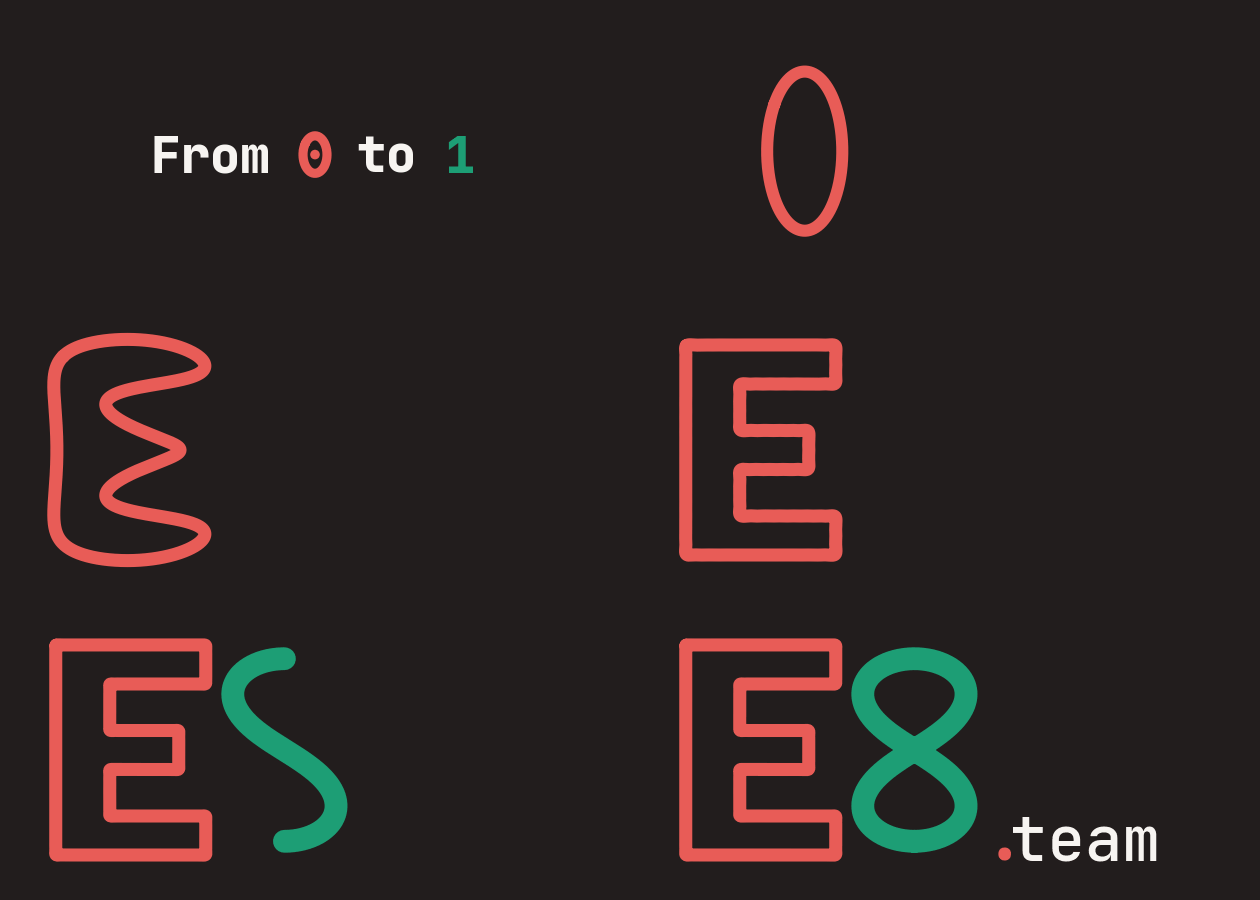
The search ran through a family of curves. A Bernoulli lemniscate read as a clean figure eight, and it carried a second meaning, the symbol of a cycle, which is what an epoch is. It became the digit 8. The letter E was harder, because no polar formula draws a letter. A Fourier series solved it: any closed contour, including the glyph of an E, is the sum of rotating circles.
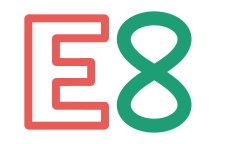
That gave the mark its story. The E is the shape a curve converges to over eight epochs of training, with the first eight harmonics accented. The clean letter sits at 160 harmonics, sampled from 1024 points along the contour. The wobble you see at low harmonic counts is the Gibbs effect: a ripple that mathematically never fully disappears, the same way a model's loss never quite reaches zero. We let that read as a feature: you can see the logo being computed. Calling the ripple a feature is the most honest marketing we have done.
What we built
The engine and the agents
As the mark is computed, a small library renders it live in the browser as a single path.
The same engine powers the budget estimator on the site, where the Fourier reconstruction runs as you drag a slider and the E rebuilds in real time.
The content runs on agents, which is how we keep the site current without a content team. We built a marketplace of six custom Claude skills that live in their own repository. The team installs them straight from the repo and they update themselves, so everyone has the current editorial set without copying files around. The skills already know the site's conventions and data formats. The pipeline goes from a description in a chat to a placed page: one skill interviews you and drafts the case or lab post, another finds where a diagram is missing and draws it in the house drafting style, a third rewrites the text to the editorial policy and places the images, and a last one lays the result into the repository and runs the checks. No skill invents numbers or client names, and none of them publishes on its own.
- 01 Describe the project in a chat with Claude (content-case-study-describe or write-lab-post)
- 02 Find the gaps and draw each schematic (illustrate-article, draw-infographic)
- 03 Edit to the house style, place images, link glossary terms (edit-to-redpolicy)
- 04 Place on the site and run the checks (place-cases-on-site)
- 05 Build: render the logo and every cover from code (lib/fourier, satori)
Stack
What the build renders
Covers from code
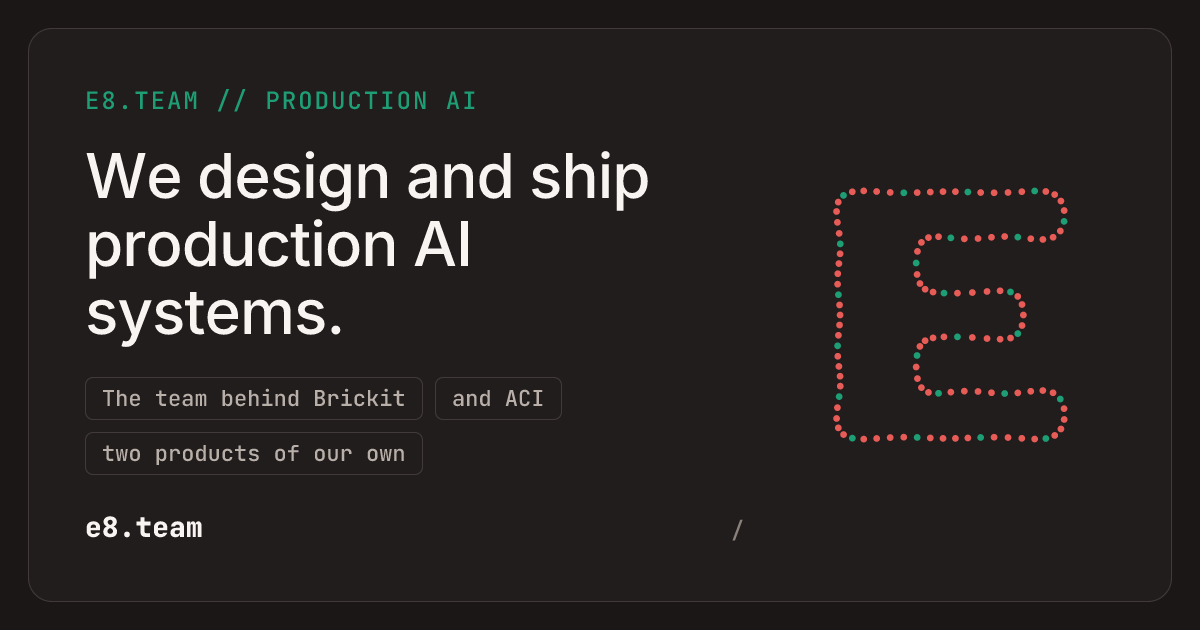
Every page needs a cover and a social preview, and we did not want stock imagery. So covers are generated at build time. One dark brand template reads the page front matter, the title, a few metrics, an accent and a motif chosen by domain, and renders the cover, the social image and the thumbnail. The motif is an abstraction of the work, bounding boxes for computer vision, graph nodes for retrieval, a trend line for analytics, the converging E for the brand itself.
What comes out
What it ships
The site is live and the design is fully programmatic, with no designer on the brand.
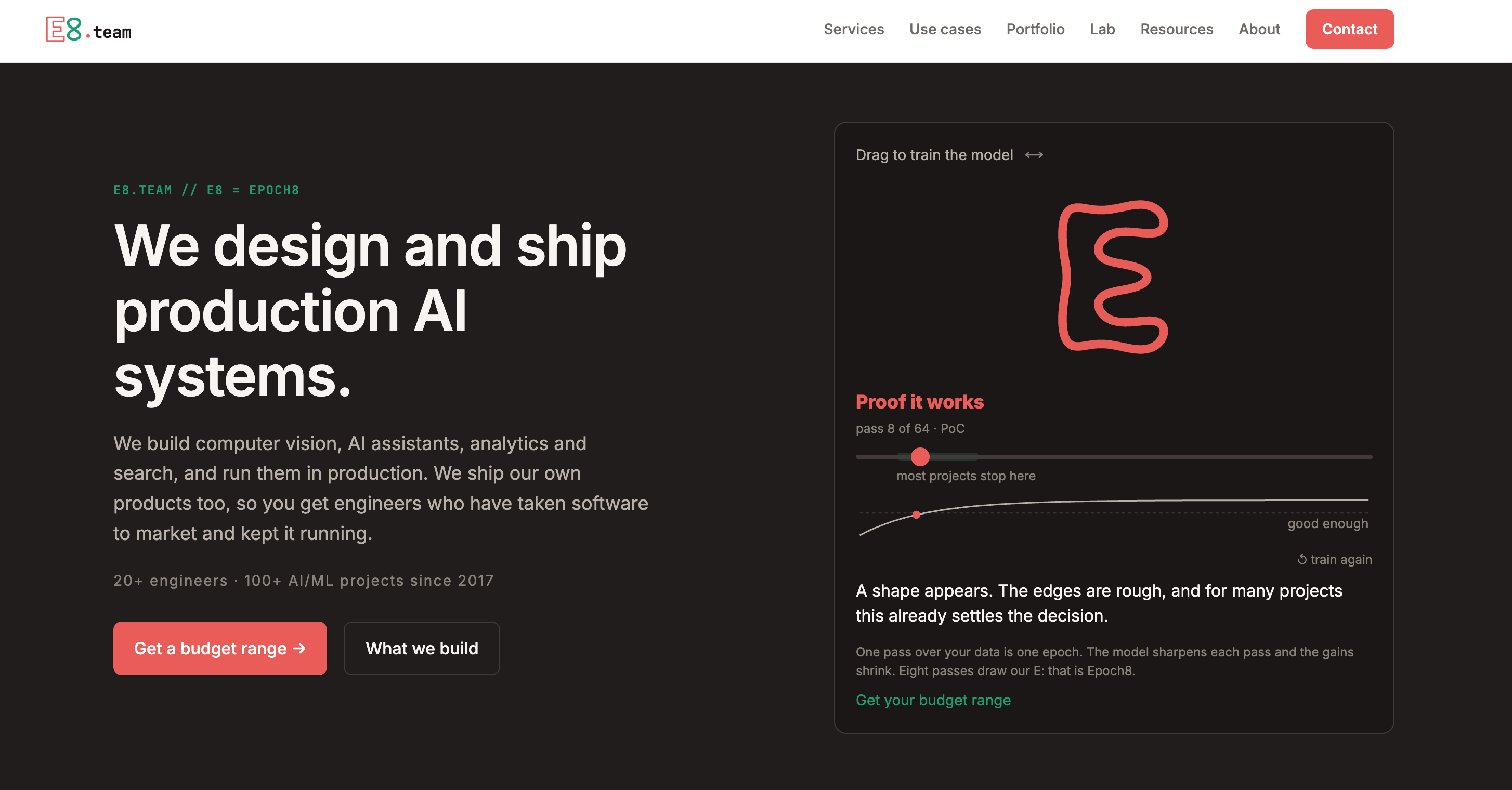
The build spec itself is part of the system: 42 design documents in the repository tell the agents how to build and maintain the site, and the skills keep the editorial set current as the team adds work. Today the site carries ten content collections, with 59 use cases, 25 portfolio cases, 22 lab posts, six service hubs and 59 glossary terms, all built and deployed from code on GitHub Pages.